Grammarly AI Checker Review: An Accuracy Test vs Know Nota
Grammarly's AI checker is the one most people meet first, because it already sits in a tool they use every day. Convenient and reliable are different things. Here is how it works, where it breaks, and what Know Nota does differently.
AI detection has become a default feature bundled into writing tools, and Grammarly's AI checker is the version most people encounter first — simply because it's already sitting in the sidebar of a tool millions of people use daily. But convenience and reliability are different things, and the two get conflated constantly in this category.
This review breaks down how Grammarly's AI checker works, where detectors of its kind are known to fail, and how Know Nota's detection model takes a structurally different approach to reporting results.
How the Grammarly AI checker works
Grammarly's AI detection sits inside a product built primarily for writing assistance, not forensic analysis — and that origin shapes how the checker behaves.
Mechanically, it's a statistical classifier. It reads submitted text and estimates how closely token-level patterns resemble language-model output versus human writing. The underlying signals are standard across this category: perplexity (how "surprised" a language model is by each next word), burstiness (sentence-level variation), and distributional regularities in punctuation and clause structure. Human writing tends to be irregular; model output tends to be smoother and more statistically predictable.
Grammarly surfaces this as a single percentage in its sidebar, alongside its usual grammar and clarity suggestions. For a Premium or Business user already working in the editor, that ambient signal is convenient — fast, bundled into an existing subscription, and available without switching tools.
One structural tension is worth noting: Grammarly also ships smoothing and rewriting features, and a workflow has emerged — often searched as "grammarly ai humanizer" — where model output is run through a paraphrase pass and then re-checked with the same vendor's detector until the flagged percentage drops. When one platform sells both the smoothing tool and the detection tool, the incentives around that detector's design deserve scrutiny.
Where detectors like this break
Two failure modes are well documented across the category, and neither is specific to Grammarly. What matters is whether a product tells you about them.
The non-native penalty. A 2023 Stanford study of seven popular detectors found they flagged essays by non-native English writers as AI-generated far more often than essays by native speakers — while native-speaker essays were almost never flagged. It is a direct consequence of using perplexity as a proxy for authorship: clean, systematically correct English — common among careful non-native speakers — statistically resembles model output more than casual native writing does. A percentage in a sidebar carries no warning about this. Grammarly publishes no false-positive rate for its checker, on non-native writing or otherwise; neither, to be clear, has Know Nota published one for non-native writing yet — the difference is that we say so on the result.
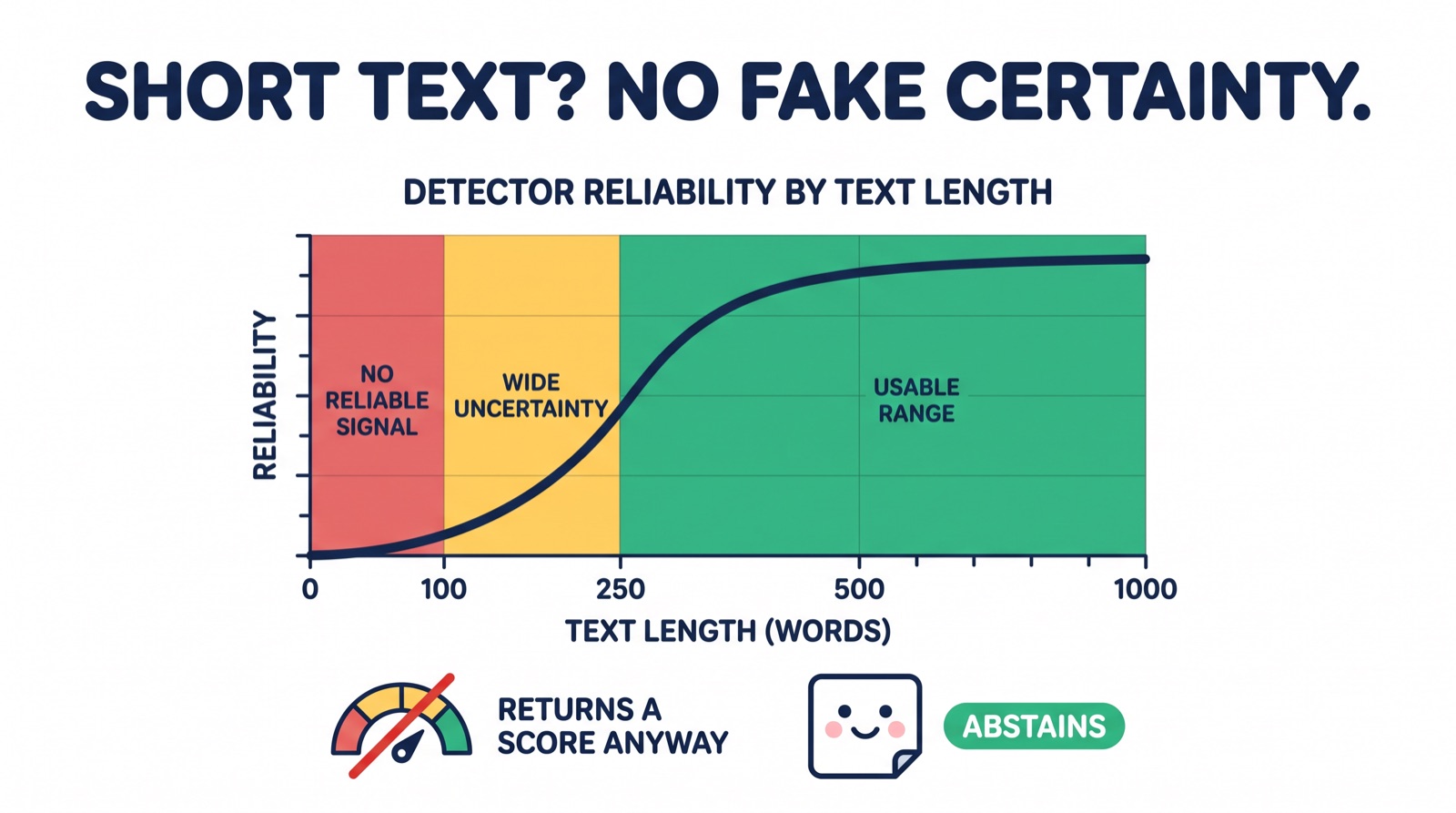
The short-text collapse. Below roughly 100 words, there is not enough statistical signal for any detector to give a reliable read; results on a short paragraph are close to noise. Grammarly still returns a confident-looking percentage regardless of length.
Where Know Nota's model differs
Know Nota's detection model draws on the same broad family of statistical signals used across the industry — there's no proprietary breakthrough being claimed here. The difference lies in six specific design decisions about what a detector is permitted to state.
1. Every score ships with how often the model is wrong
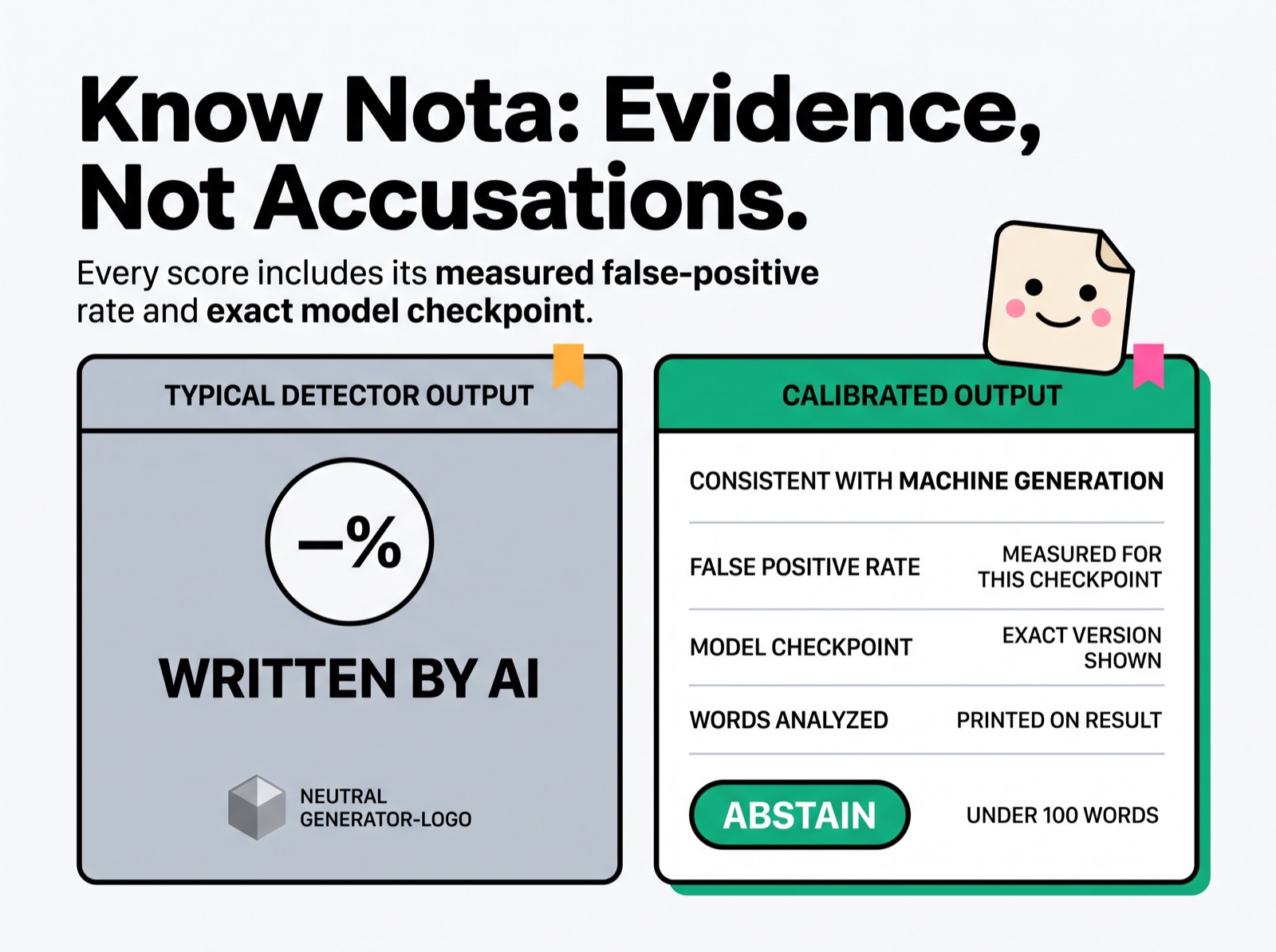
Each Know Nota result includes the false-positive rate measured for the exact model that produced that score, at the length of the text you scanned — not an aggregate figure or a number from a prior release. A reading of 94 out of 100 comes with the rate at which this model calls genuine human writing of that length AI, so the reader knows how much to trust it before acting on it.
2. It tells you when text is too short to trust
Under 10 words, Nota gives no score. From 10 to 49 words it gives one, with a plain warning: in our own test, about 1 in 3 human texts that short was wrongly read as AI. The test is published, so you can see how unreliable a short result is before you act on it.
3. It never states "written by AI"
Results use calibrated language: a text looks like AI writing to this model, or looks like human writing — never "written by AI." A classifier observes statistical properties, not authorship, and cannot reliably distinguish a human writer using clean parallel structure from a model doing the same. This phrasing is designed to support a conversation rather than deliver a verdict.
4. It never names a specific generator
Know Nota does not attribute flagged text to ChatGPT, Claude, Gemini, or any named tool. Model outputs converge heavily across vendors, fine-tunes proliferate, and paraphrasing layers obscure whatever signature might otherwise exist. Naming a specific generator would add apparent authority without added accuracy.
5. Pasted text is discarded by default
Submitted text is not retained unless the user explicitly chooses to keep it inside a signed record. This default protects users handling sensitive material — embargoed manuscripts, candidate writing samples, student work — and removes ambiguity around data retention for organizations with compliance requirements.
6. Model version and word count print on every result
Every output includes the model version and the word count analyzed, supporting reproducibility. If a result changes on a re-run, the version stamps clarify whether the model or the text changed.
Head to head, by use case
Students self-checking before submission: Grammarly's in-editor convenience is a real advantage. However, flagged paragraphs in genuinely original writing are common, particularly for non-native English speakers. Rewriting sound prose to satisfy a classifier score is not recommended. If you are ever flagged, a record of how the document was written is stronger evidence than any score — which is what Know Nota's Writing Record is for — here is what version history does and does not prove.
Educators and schools: This is where the gap matters most. Any score informing a disciplinary conversation should come with a false-positive rate, no score on short submissions, non-accusatory language, and a version stamp. A bare percentage from any AI content detector is unlikely to hold up under appeal.
Editorial and publishing teams: Default-discard handling and reproducible version stamps matter more than marginal accuracy differences, since most editorial workflows use detection to flag content for human review rather than to reject it outright.
Hiring teams: Writing samples submitted in hiring processes are often short, and short results are often wrong — extending the assignment length or excluding automated detection from short samples is advisable.
Developers: Teams embedding detection into an LMS, CMS, or submission pipeline need structured, machine-readable output — false-positive rate, model version, and word count as first-class fields — rather than a single number.
Test it yourself
Take a document with a known origin — something written before November 2022, and something confirmed to be model-generated — and run both through Know Nota. Compare the reading, the attached false-positive rate, the model version, and the word count analyzed. Then try a 30-word excerpt and read the warning that comes with it.
Run your first check at Know Nota → No account required for a single document, and submitted text is not retained unless you choose to keep it in a signed record. Developers can access the API with the false-positive rate, model version, and word count returned as structured fields.